Test with confidence, code with clarity
Your home for mastering Test-Driven Development through real-world katas and expert guidance.
Practice TDD with a curated set of real-world katas, each with clear requirements and test cases.
Browse KatasLearn best practices, naming conventions, and advanced TDD techniques from industry experts.
Explore GuidesDiscover the TDD Gears model and learn how to apply TDD principles in real-world scenarios.
Learn MorePopular exercises to sharpen your TDD skills
Score a game of bowling. Handle spares, strikes, and edge cases. A classic kata for learning incremental design.
Start KataA twist on the classic FizzBuzz problem. Great for practicing basic TDD cycles and edge case thinking.
Start KataConvert between Roman and Arabic numerals. Focuses on validation, algorithms, and incremental refactoring.
Start KataThe bar for "good tests" just moved. Agents made it non-optional.
Read the argument: The Bounded Context Is the Scope the Agent Actually Needs
Tests exist and pass. Good enough for humans with context.
Scenario names · builders · domain types · ubiquitous language. The test suite is the interface agents operate against.
Shift gears based on context, not habit
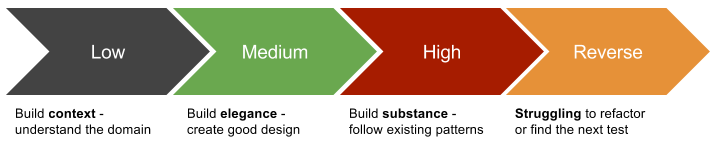
New territory. Build context. Small steps. Learn the shape of the problem before solving it.
Patterns emerge. Apply design principles. Let the tests guide you toward better abstractions.
Known patterns. Follow existing architecture. Move fast because the structure is already proven.
Wrong direction. Back up. Delete the test. Try a different approach. This isn't failure — it's steering.